


Commonly Asked Questions
Lot owners who are planning to renovate their unit must understand the types of renovations and their obligations to notify the owner’s corporation of their renovations for approval. There are three different types of renovations. These are:
1. Cosmetic work – this does not require approval with the owner’s corporation. Cosmetic works include but are not limited to:
- Installing or replacing hooks, nails, screws, handrails, internal blinds, internal curtains or built-in wardrobes
- Painting the interior
- Filling minor holes and cracks in internal walls and;
- Laying carpet
2. Minor renovations – this requires approval from the strata committee and / or owner’s corporation (dependent on the building’s bylaws in relation to approval of minor renovations). Minor renovations include, but are not limited to:
- Kitchen renovations (for example, installing or removing cupboards);
- Changes to recessed light fittings;
- Install or replacement of wood, tile or other hard flooring, including removing carpets;
- Install or replacement of wiring, cabling, power, or access points;
- A rainwater tank;
- Clothesline;
- Reverse cycle air conditioner;
- Double or triple glazed windows;
- A heat pump;
- Ceiling insulation
3. Major renovations – this requires a ‘special resolution vote’ at a general meeting of the owners corporation. This means that for your major renovation to get approved, no more than 25% of the value of the votes are against the work. To approve sustainability renovations or those which improve access for a person with a disability, no more than 50% of the value of the votes can be against the work. If your work will change the structure of your property, you must also give the owners corporation 14 days’ written notice before the work starts. The written notice should describe how your renovations will change the property structure. Major renovations include:
- structural changes (i.e. removing a wall or moving a structural wall;
- Changes that affect the external appearance of your property;
- Changes that require waterproofing;
- Changes to the ceiling and;
- Work that needs approval under other laws (for example, council approval).
If you would like to apply for a renovation in your unit, please refer to the Renovations webpage here and complete the form here.
Building defects remain one of the most challenging and costly issues faced by strata communities. A building defect may arise from faulty workmanship, defective materials, poor design, or construction that does not comply with applicable building standards and regulations.
As defined by the NSW Government, major building defects include:
- Failed waterproofing;
- Fire safety defects;
- Structural defects;
- Building enclosure defects and;
- Building services defects (i.e. poor ventilation, non-compliant duct sealing and other ducting systems)
Effective strata management assists Owners Corporations in identifying, investigating, and addressing building defects in a timely manner. Depending on the circumstances, this may involve working with the original builder or developer to rectify defects within the applicable statutory warranty period, engaging qualified consultants to assess the issues, or obtaining legal advice to pursue available remedies and protect the interests of the Owners Corporation.
For more information about managing building defects in NSW, please refer to the link here.
Lot owners and residents in buildings are able to keep a pet in their unit, subject to approval from the strata committee. Owners and tenants must ensure that:
- Pets do not disrupt or interfere the peace and enjoyment of other residents;
- Pets are ALWAYS supervised on a leash in the common areas to prevent hazards to other residents in the building;
- They must comply with the building’s bylaws in relation to keeping of animals.
An owner’s corporation may issue a notice to comply with the bylaw if the pet continually causes interference or if they breach the building’s pet bylaws. If the behaviour continues, the owner’s corporation may order the landlord / tenant to remove their pet off the premises.
If you would like to apply to keep a pet on the premises, click on the following link to complete the form here.
The strata industry in New South Wales has undergone a number of legislative reforms since 2025, aimed at strengthening transparency, accountability, and governance across strata schemes. These reforms place greater emphasis on the professional conduct of strata managing agents, ensuring they carry out their duties in accordance with the Strata Schemes Management Act 2015 and other relevant legislation.
The reforms are also intended to provide greater protection and confidence for current and prospective lot owners by improving access to information, supporting informed decision-making, and enhancing understanding of the rights and responsibilities that apply within strata communities. By establishing clearer obligations and regulatory requirements, the reforms help promote best practice within the strata sector while reducing potential risks for owners corporations, strata managers, and other stakeholders.
For more information about the strata law reforms, click on the following link
Strata levies (fees) are your contribution towards the management and upkeep of the scheme. All owners must pay levies to cover costs such as:
- Building insurance;
- Management costs;
- Common property repairs and maintenance and;
- Utilities in common areas (for example lights).
All strata schemes have an administrative fund and a capital works fund to administer the finances of the strata scheme.
Classification of levies
The levies are classified into two different types of funds. These are:
| Administrative fund | Capital works fund (sinking fund) |
Day-to-day expenses of running the scheme including:
|
One off, or major expenditure, such as:
|
The levies are classed Levies are usually paid quarterly. They are typically set at each annual general meeting (AGM), after the budget is adopted. The treasurer or strata managing agent works out the levy amount each owner pays. This is based on their unit entitlement. Unit entitlement determines your share of ownership in the strata scheme and how much you’ll pay to maintain it. It also affects your voting power in some decisions the owners corporation makes. Check the strata plan to find out the unit entitlement for your lot. Note that your lot number (against which will be your unit entitlement) may not be the same as your unit number. For example, unit 1 may be lot 2.
For more information about levies, click on the following link
A 10-Year Capital Works Fund Plan is a strategic document that assists the owners corporation in planning for anticipated major repairs, maintenance, renewal, and replacement of common property assets. The plan provides estimated costs and funding requirements, enabling the owners corporation to raise sufficient contributions through the Capital Works Fund to meet future expenditure.
Under the Strata Schemes Management Act 2015, a capital works fund plan must be prepared from the first Annual General Meeting (AGM) of the owners corporation and must cover a period of at least 10 years. The plan must be reviewed at least every five years and considered at each AGM. Any updates, revisions, or replacement plans are subject to approval by the owners corporation.
From 1 April 2026, owners corporations are required to use the NSW Fair Trading mandatory 10-Year Capital Works Fund Plan template when preparing or reviewing their plan. The plan must include estimates and funding provisions for the repair, maintenance, renewal, and replacement of common property, while also considering opportunities to improve the sustainability, energy efficiency, and environmental performance of the strata scheme.
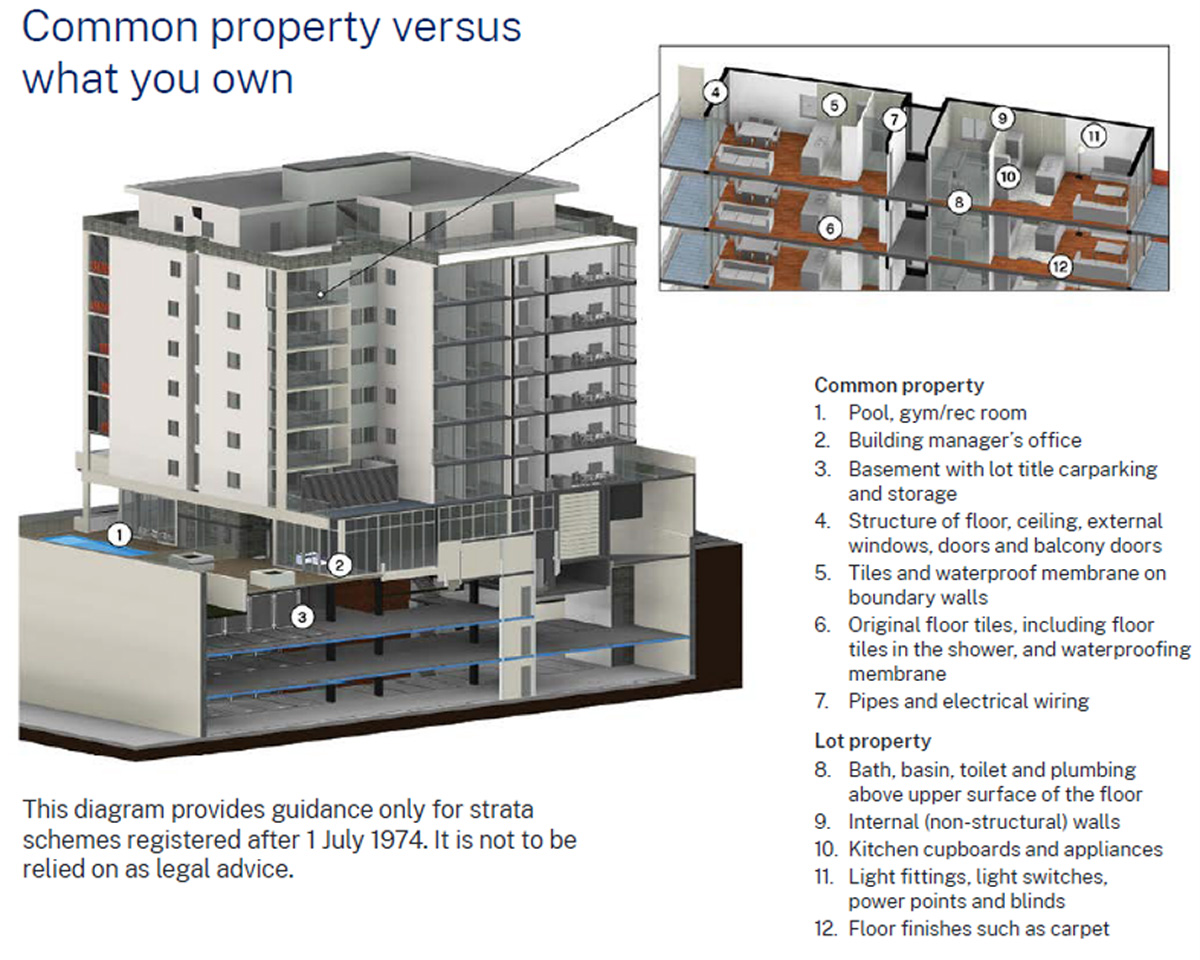
One of the most common requests raised by owners in apartment buildings is understanding who is responsible for the repairs and maintenance within a lot, whether it is an owner’s corporation responsibility or whether it is a lot owner’s responsibility.
In summary, all the elements of the property that fall within the cubic air-space of the lot are the lot owner’s responsibility to maintain. This includes internal (non-structural) walls, lights, internal curtains and blinds, carpets, toilets and baths, kitchen cupboards, bench tops and appliances.
Those areas that fall outside the lot are considered to be common property and the Owners Corporations responsibility to maintain and repair. This includes common and structural walls, external doors, roofs, shared pipes serving multiple lots, electrical wiring and external windows.
To easily determine the classification between common property and lot property, see the diagram.
In an ever-evolving regulatory environment, it is important for owners corporations, strata committees, building managers, developers and fire safety practitioners to remain informed of legislative changes that affect the safety and compliance of their strata scheme. Recent fire safety reforms have introduced a range of new requirements that schemes must understand and comply with to ensure the ongoing protection of residents and property.
Since 2023, the NSW Government has implemented reforms to strengthen fire safety compliance and improve the design, certification, and maintenance of fire safety measures within buildings. These reforms include:
- Increased involvement of Fire and Rescue NSW (FRNSW) in the assessment of non-standard fire safety designs and performance solutions.
- The introduction of an independent checker role to verify that newly installed fire safety measures have been correctly designed and implemented before a building is occupied.
- Improved documentation and record-keeping requirements through the standardisation of fire safety documentation and streamlined amendment processes.
- Mandatory procedures for the inspection, testing, and maintenance of fire safety measures to ensure ongoing compliance throughout the life of the building.
These reforms aim to improve building safety, strengthen accountability across the construction and strata sectors, and provide greater confidence that fire safety systems are operating as intended.
For more information about the NSW fire safety reforms, you can click on the following link.
What is Building Insurance?Strata Building Insurance protects the Owners Corporation for damage sustained to the building as a result of an Accidental or Malicious act.
Common examples are:
- Fire / Arson
- Vandalism
- Glass Breakage
- Burglary & Theft
- Burst Pipes
- Earthquakes
- Storm / Tempest
- Lightning Strikes
- Vehicular Impact
A common misapprehension is that Strata Building Insurance protects the Owners Corporation for the routine maintenance items or building defects such as the repair of leaking shower trays, settlement/movement cracks in walls & ceilings or concrete cancer, unfortunately this is not the case. The easiest comparison to think of is motor vehicle insurance. You can insure your vehicle against having an accident, however you cannot insure your vehicle for wearing out. This same principle applies to Strata Building Insurance.
How is an Owner of a Lot Property Protected?Every Owners Corporation has a mandatory duty to insure ‘the building’ against accidental or malicious damage – section 160 (1), Strata Schemes Management Act 2015 (the Act).
Lot space within a strata scheme is commonly defined as:
“the cubic air-space contained within the inner surface of the boundary walls, under surface of the ceiling and upper surface of the floor”
Under this definition the lot owner is responsible for the repair, replacement and maintenance of all building components housed within the lot, such as:
- Internal Walls
- Internal Doors
- Toilets, Baths & Basins
- Shower Screens
- Built in Wardrobes
- Kitchen Sinks, Cabinets and Bench Tops
- Appliances, such as wall and bench ovens, cook tops, range hoods, hot water heaters, bathroom & laundry exhaust fans
For example, a leaking tap washer in the kitchen or leak through a shower screen is the lot owners’ responsibility to maintain. However, by virtue of the term ‘the building’ being included in section 160 (1), many of the building components contained within the ‘lot’ are protected by the mandatory Building Insurance that is taken out by the Owners Corporation.
Simply speaking these items are the lot owners’ responsibility for the purposes of repair, replacement and maintenance, however they are protected by the Strata Building Insurance if damaged via an insurable event.
Are my Contents covered?No, the contents and fittings contained within your lot ARE NOT protected by the Strata Building Insurance and are specifically excluded from the policy, items such as:
- Carpets and underlay
- Light fittings
- Any furnishing or personal contents
- Floating floorboards
- Paint work on walls & ceilings
- Electrical appliances that are not hardwired into the building e.g. clothes dryers, dishwashers or microwaves, TVs etc
- Wallpaper
- Wall tiles located on internal walls
- Curtains and blinds
Owner-occupiers may extend the cover on their contents insurance to include the items not covered by the strata building Insurance. Most major mainstream insurers in NSW are aware of the delineation between strata building insurance and contents insurance for a strata property and are happy to extend home contents insurance to include the items listed above.
Non-resident or investor owners may take out ‘Landlords Insurance’ for a sufficient sum to cover the fittings of their lot. However all owners should undertake their own inquires with their insurer or insurance broker to ensure their contents are adequately protected by their contents policy.